
Building Wealth in a World Designed for Spending
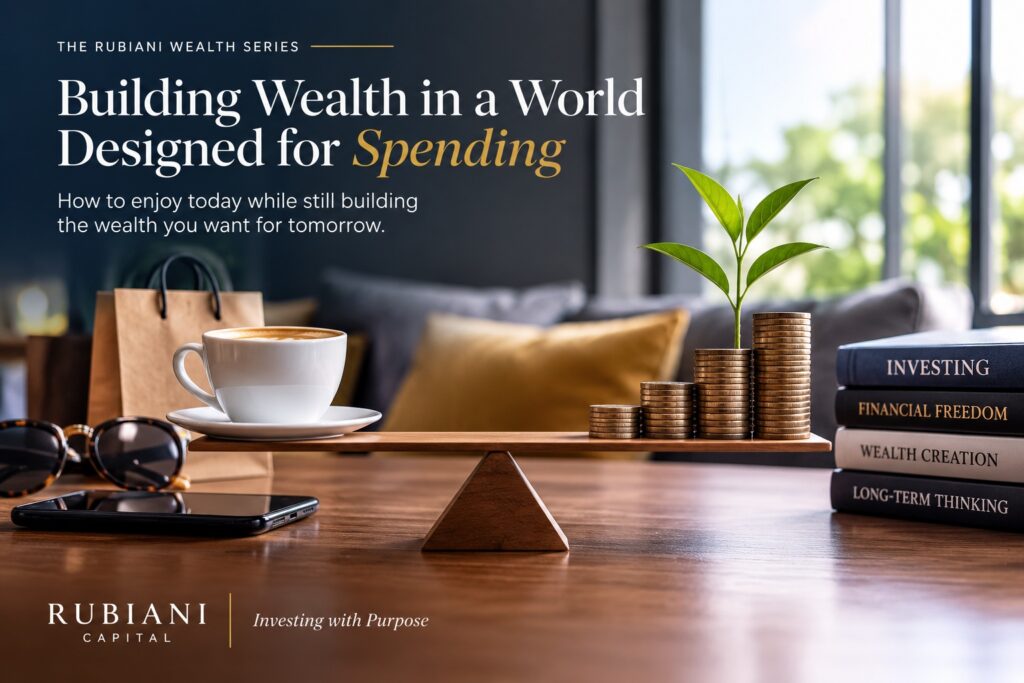
There was a time when spending money required effort.
You had to walk into a shop. Withdraw cash. Count the notes. Hand them over. And, perhaps most importantly, physically watch your money leave your hands.
Today, spending can take seconds.
Tap.
Swipe.
Click.
Order.
Subscribe.
Buy now. Pay later.
From food delivery and online shopping to streaming subscriptions, ride-hailing apps and one-click checkouts, modern life has become extraordinarily good at removing the friction between wanting something and paying for it.
And that convenience is wonderful.
Until we realise that while technology has made spending easier, building wealth has not become automatic.
That still requires intention.
We Are Not Just Buying More. We Are Thinking About Spending Less.
One of the biggest changes in modern consumption is not necessarily what we buy.
It is how little time we now have to think before buying it.
Imagine seeing a pair of shoes you like twenty years ago.
You might have seen them in a shop window. You would probably have gone home, thought about them, perhaps discussed the purchase and returned another day if you still wanted them.
Today?
You see the shoes while scrolling through your phone.
You click.
Your payment details are already saved.
The shoes could be on their way to you before you have even finished your cup of tea.
The gap between “I want it” and “I bought it” has almost disappeared.
For consumers, this is convenient.
For businesses, it is brilliant.
For wealth building, however, it creates an interesting challenge.
Because wealth often grows in precisely that gap.
The moment where we stop and ask:
Do I want this more than I want what this money could become?
The KES 1,000 That Doesn’t Feel Like KES 1,000
Consider an ordinary Saturday.
Coffee and breakfast: KES 1,500.
A delivery because cooking feels inconvenient: KES 2,000.
A few items added to an online shopping cart: KES 4,500.
A ride across town instead of driving: KES 1,200.
A subscription renewed automatically: KES 1,000.
None of these purchases necessarily feels extravagant.
And importantly, none of them is inherently wrong.
Money is meant to support a good life.
The challenge is that modern spending rarely arrives as one dramatic KES 100,000 decision.
It often arrives quietly.
KES 800 here.
KES 1,500 there.
KES 3,000 somewhere else.
Each amount feels manageable in isolation.
But wealth does not see individual transactions.
Wealth sees the total.
And over a month, a year or a decade, those seemingly insignificant decisions can become substantial.
But This Is Not About Giving Up Coffee
Personal finance conversations sometimes become unnecessarily punitive.
Stop buying coffee.
Never eat out.
Cancel everything.
Don’t travel.
Don’t enjoy yourself until retirement.
That is not a particularly inspiring definition of financial freedom.
Building wealth should not require putting your life on hold.
After all, what is the purpose of financial wellbeing if we cannot enjoy the life we are working so hard to build?
The real question is not:
“How do I stop spending?”
It is:
“How do I enjoy my money today while still allowing enough of it to build my tomorrow?”
That is a very different conversation.
The Problem Is What Happens Before We Invest
Most of us understand the basic formula.
Earn.
Spend.
Save.
Invest.
But there is a weakness in that sequence.
If investing happens after spending, spending gets first claim on our income.
And spending is remarkably good at expanding to fill the space available.
A salary increase comes.
The house gets slightly bigger.
The car gets slightly better.
Weekends become slightly more expensive.
Subscriptions multiply.
Convenience becomes normal.
Soon, the additional income that was supposed to make us wealthier has simply made our lifestyle more expensive.
We earn more.
We spend more.
But our financial position does not improve nearly as much as our income suggests it should.
There is another way.
Earn → Invest → Spend intentionally.
The difference may appear small.
Over time, it can be enormous.
Give Your Future Self First Claim
One of the simplest wealth-building principles is also one of the most powerful:
Invest before you spend.
Not whatever happens to remain at the end of the month.
A deliberate amount.
Imagine earning KES 200,000 per month and deciding that KES 30,000 belongs to your future before the month begins.
Once that investment happens automatically, your spending decisions are made around the remaining KES 170,000.
The alternative is to spend from KES 200,000 all month and hope KES 30,000 remains.
Those two approaches may look mathematically identical.
Behaviourally, they are completely different.
One makes investing optional.
The other makes it normal.
And wealth is often built when good financial decisions become systems rather than monthly negotiations with ourselves.
Make Investing as Easy as Spending
There is an interesting lesson we can borrow from the companies that have become exceptionally good at getting us to spend.
They remove friction.
Your card details are saved.
Your preferences are remembered.
Your subscription renews automatically.
Your favourite order is one click away.
What if we applied the same thinking to wealth?
Automate the monthly investment.
Create a standing order.
Increase the investment automatically when income increases.
Reinvest income from investments where appropriate.
Set financial goals before lifestyle goals.
In other words:
If spending is effortless, investing should be effortless too.
We should not have to wake up every month and rediscover the discipline to build wealth.
Enjoy the Rest — Without Guilt
There is another benefit to investing first that is rarely discussed.
It can actually make spending more enjoyable.
If you know that your retirement contribution has been made, your emergency reserve is healthy, your children’s education plan is progressing and your long-term investments are growing, spending some of what remains becomes much easier to enjoy.
Take the holiday.
Have dinner with friends.
Buy something you have wanted.
Upgrade something that genuinely improves your life.
The objective is not financial guilt.
It is financial alignment.
You know that today’s lifestyle is not quietly stealing from tomorrow’s goals.
That is a healthier relationship with money than either extreme — spending everything today or being afraid to enjoy anything because every shilling could theoretically have been invested.
Create Some Friction Where It Matters
If technology has removed the friction from spending, we can deliberately put a little of it back.
Not everywhere.
Just where it helps.
Before an unplanned purchase, wait.
For smaller purchases, perhaps a few hours.
For larger ones, perhaps a day or several days.
Remove saved payment details from the shopping apps where impulse spending tends to happen.
Review recurring subscriptions periodically.
Ask yourself whether something is genuinely improving your life or has simply become habitual spending.
And occasionally ask one powerful question:
“Would I still buy this if I had to pay cash for it?”
The objective is not to prevent yourself from buying things you enjoy.
It is simply to put a small amount of thinking back between wanting and buying.
Your Income Does Not Build Wealth. The Gap Does.
We often assume that people with high incomes automatically become wealthy.
Not necessarily.
A person earning KES 500,000 and consistently spending KES 480,000 may have less capacity to build wealth than someone earning KES 250,000 and deliberately investing KES 60,000 every month.
Income matters.
But so does the gap between what we earn and what we consume.
That gap is where capital comes from.
Capital becomes investments.
Investments generate returns.
Returns compound.
And, given enough time, that process creates wealth.
This is why increasing income without protecting the gap can be surprisingly ineffective.
As earnings rise, the goal should not be to prevent lifestyle improvement altogether.
It should be to ensure that our investments grow alongside our lifestyle.
Perhaps even faster.
Wealth Is Ultimately About Choice
There is an irony in modern consumer culture.
We are surrounded by more choices than almost any generation before us.
But if every increase in income immediately creates an increase in spending commitments, our financial choices can actually become smaller.
The expensive lifestyle must be maintained.
The bills must be paid.
The next salary becomes necessary before it even arrives.
Wealth changes that relationship.
Not because wealth means never working again or buying everything you want.
But because accumulated financial resources create options.
The option to change careers.
The option to take a break.
The option to start a business.
The option to support family.
The option to retire with dignity.
The option to say no.
The option to say yes.
And perhaps that is one of the most useful ways to think about investing:
We are not simply accumulating money. We are accumulating future choices.
A Weekend Thought
As you go through this weekend, notice how easy it is to spend.
The coffee order.
The delivery.
The online cart.
The subscription.
The quick M-PESA payment.
Enjoy the things that genuinely add value to your life.
But occasionally remember:
Someone has worked very hard to make spending effortless.
We may need to work just as deliberately to make investing effortless too.
Because building wealth does not mean choosing between enjoying today and preparing for tomorrow.
The goal is to build a financial life capable of doing both.
The Rubiani Perspective
At Rubiani Capital, we believe wealth is built through intentional choices repeated consistently over time.
A good financial plan should not make you feel guilty about enjoying your money. Neither should today’s lifestyle continuously postpone tomorrow’s financial freedom.
The objective is balance.
Build the systems that allow part of your income to consistently work for your future.
Then give yourself permission to enjoy the life you are building today.
Because financial freedom is not simply about having more money.
It is about having more choices.
Rubiani Capital — Investing with Purpose. #RubianiWealthSeries #BuildingWealth #WealthCreation #PersonalFinance #FinancialFreedom #Investing